IT Infrastructure Security Best Practices for Growing Businesses

Why IT Infrastructure Security is Non-Negotiable for Growing Businesses
As businesses grow, so does their attack surface. Every new employee, device, application, and network connection introduces potential vulnerabilities. For growing companies, the challenge is particularly acute: they face the same sophisticated threats as large enterprises but often lack dedicated security teams and enterprise-grade tools.
The statistics are alarming. 43% of cyberattacks target small and medium-sized businesses, and 60% of SMBs that suffer a significant cyberattack go out of business within six months. Yet investing in robust IT infrastructure security is not just about avoiding disaster — it is about creating a competitive advantage through trust, compliance, and operational resilience.
Building a Multi-Layered Security Architecture
Effective IT security is never about a single product or solution. It requires a defense-in-depth approach with multiple overlapping layers of protection. Here is the framework that every growing business should implement:
Layer 1: Network Perimeter Security
Your network perimeter is the first line of defense against external threats. Essential components include:
Next-Generation Firewalls (NGFW) Modern firewalls go beyond simple packet filtering. They provide deep packet inspection, application awareness, intrusion prevention, and threat intelligence integration. A properly configured firewall can block the vast majority of external attack attempts.
Intrusion Detection and Prevention Systems (IDS/IPS) These systems monitor network traffic for suspicious patterns and known attack signatures. When a threat is detected, IPS can automatically block the malicious traffic before it reaches your internal systems.
DNS Filtering and Web Security Blocking access to known malicious domains and categories prevents employees from accidentally visiting phishing sites or downloading malware. DNS-level filtering is one of the most cost-effective security measures available.
Layer 2: Endpoint Protection
Every device connected to your network is a potential entry point for attackers. Comprehensive endpoint protection includes:
- Next-generation antivirus (NGAV) that uses behavioral analysis instead of just signature matching
- Endpoint Detection and Response (EDR) for real-time monitoring and automated threat response
- Mobile Device Management (MDM) to secure smartphones and tablets
- Full-disk encryption to protect data on lost or stolen devices
- Application whitelisting to prevent unauthorized software execution
Layer 3: Identity and Access Management
Controlling who has access to what is fundamental to security. Best practices include:
- Multi-Factor Authentication (MFA) for all user accounts, especially administrative access
- Role-Based Access Control (RBAC) to ensure users only have the permissions they need
- Privileged Access Management (PAM) to monitor and control administrative accounts
- Single Sign-On (SSO) to reduce password fatigue while maintaining security
- Regular access reviews to remove permissions when employees change roles or leave
Layer 4: Data Protection and Encryption
Protecting your data — both at rest and in transit — is critical:
- TLS/SSL encryption for all data in transit
- AES-256 encryption for data at rest on servers and storage devices
- Database encryption for sensitive customer and financial information
- Data Loss Prevention (DLP) tools to prevent unauthorized data exfiltration
- Data classification policies to identify and protect sensitive information
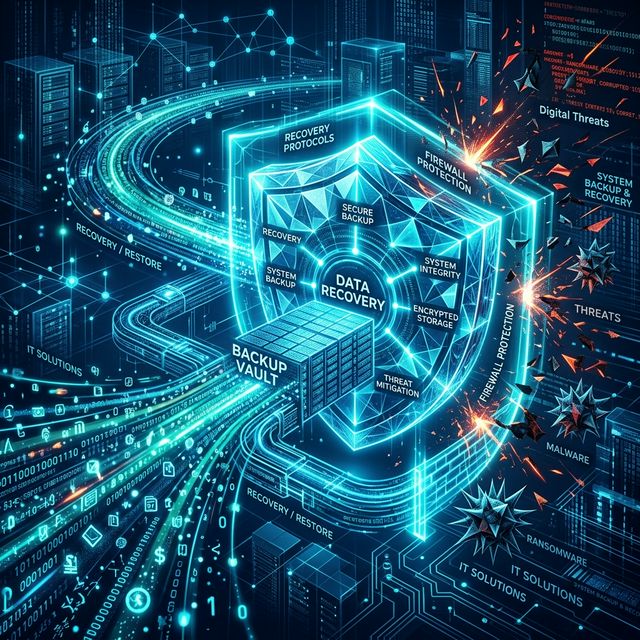
Layer 5: Backup and Disaster Recovery
No security solution is 100% effective. When a breach or disaster occurs, your backup and recovery strategy determines how quickly you can return to normal operations:
The 3-2-1-1-0 Backup Rule:
- 3 copies of your data
- 2 different storage media types
- 1 copy stored offsite
- 1 copy stored offline or air-gapped
- 0 errors after backup verification testing
Recovery Time and Point Objectives: Define clear Recovery Time Objectives (RTO) and Recovery Point Objectives (RPO) for each critical system. Test your disaster recovery procedures at least quarterly to ensure they work when you need them.
Security Operations: The Human Element
Technology alone is not enough. Effective security requires trained people and well-defined processes:
Employee Security Awareness Training
95% of cybersecurity breaches are caused by human error. Regular training should cover:
- Identifying phishing emails and social engineering attacks
- Password hygiene and the importance of MFA
- Safe browsing and download practices
- Incident reporting procedures
- Physical security awareness (tailgating, clean desk policy)
Vulnerability Management Program
A structured vulnerability management program includes:
- Regular vulnerability scanning of all internal and external assets
- Penetration testing at least annually (or after major infrastructure changes)
- Patch management with defined timelines based on severity
- Risk assessment to prioritize remediation based on business impact
- Continuous improvement through lessons learned and trend analysis
Incident Response Planning
Every business needs a documented incident response plan that covers:
- Roles and Responsibilities — who does what during a security incident
- Communication protocols — how to notify stakeholders, customers, and regulators
- Containment procedures — steps to limit the impact of a breach
- Evidence preservation — how to collect and protect forensic evidence
- Recovery procedures — how to restore systems and validate integrity
- Post-incident review — how to learn from the incident and improve defenses
Compliance as a Security Foundation
For many businesses, security is not optional — it is mandated by regulation. Key frameworks to consider:
| Framework | Applies To | Key Requirements | |:---|:---|:---| | GDPR | Any business handling EU citizen data | Data protection, breach notification, privacy by design | | ISO 27001 | Organizations seeking certification | Information Security Management System (ISMS) | | NIS2 Directive | Essential and important entities in the EU | Risk management, incident reporting, supply chain security | | PCI DSS | Businesses accepting card payments | Cardholder data protection, network security |
How CyberNet Secures Your Infrastructure
At CyberNet, we implement comprehensive, multi-layered security for businesses across Albania and the Balkans. Our security services include:
- Security assessments and vulnerability scanning to identify risks before attackers do
- Managed firewall and IDS/IPS monitoring with 24/7 threat response
- Endpoint protection deployment with EDR across all workstations
- Identity and access management including MFA and RBAC implementation
- Automated backup and disaster recovery with regular testing
- Compliance consulting for GDPR, ISO 27001, and NIS2
- Employee security awareness training programs
With over 10 years of experience and 500+ clients protected, we understand the unique security challenges facing growing businesses.
Worried about your security posture? Contact CyberNet today for a free security assessment and discover where your infrastructure may be vulnerable.
Originally published on CyberNet