Enterprise IT Solutions for Intelligent Business Growth

Business growth begins with drive and market demand, but it relies on stable, secure, and well-managed technology. Slow systems, inconsistent backups, or reactive support drain time and erode confidence in the tools meant to drive progress. An effective IT strategy paired with robust cybersecurity practices forms the cornerstone of this technology framework.
That is why IT solutions designed for enterprise-level performance matter not just to large corporations. For growing companies, these solutions provide the framework to support expansion, safeguard data, improve system reliability, and empower staff to work smoothly without ongoing technical setbacks. Embracing digital transformation through such strategic investments often streamlines processes like ERP (enterprise resource planning) and business intelligence, enhancing overall operational efficiency.
Why enterprise IT solutions matter now
Enterprise IT solutions go beyond the size of a company. They are measured by maturity, resilience, and the ability to support operations at a high level. A smaller firm with strict uptime requirements, sensitive customer data, and dispersed teams may require these systems as urgently as a multinational organization.
Many businesses eventually find that informal IT methods no longer work. A single server error can delay billing, a missed update creates a security risk, and one failed backup can lead to a major operational problem. At this point, a series of stopgap fixes is not enough. The business needs a cohesive system to prevent recurring issues while integrating tools like customer relationship management and automation that drive seamless operations.
Deploying a robust IT model shifts the focus from fixing problems quickly to preventing them altogether. Leaders begin to ask how to avoid issues rather than how to remedy them after they occur. This proactive stance extends to integrated ERP systems and supply chain management, ensuring every part of the business process is harmonized.
What falls under enterprise IT solutions
This term covers more than hardware, software, or a basic help desk agreement. It means a coordinated set of services, controls, and infrastructure practices that keep systems reliable and secure while supporting long-term business growth.
For many organizations, this includes cloud resources, endpoint management, server administration, network monitoring, backup and disaster recovery, identity controls, security policies, and remote support. The strength lies in how these elements function together rather than in any one tool. Integrating an IT strategy with cybersecurity, digital transformation, and automation elevates operational efficiency.
Key components include:
- Server administration
- Network monitoring
- Endpoint protection
- Cloud infrastructure
- Backup and recovery
- Access control
- Performance optimization
- Remote technical support
- ERP and enterprise resource planning functionalities
- Business intelligence reporting
When these services are managed as a single environment rather than as isolated purchases, businesses benefit from consistent updates that follow set policies, easier enforcement of security measures, fewer interruptions, and more predictable costs.
The shift from reactive IT to proactive IT
Reactive support waits for a system to fail before taking steps to fix it. Proactive support, by contrast, reduces the likelihood of failure from the start. This shift can boost productivity, tighten cybersecurity, and ensure business continuity.
While reactive support might seem manageable initially, constant disruptions lead to delays, loss of focus, missed sales, and increasing overall risk. A proactive approach means that systems are monitored continuously, capacity issues are spotted early, patches are applied on schedule, backups are tested, and security alerts are reviewed promptly. Embracing proactive IT strategies that incorporate automation and digital transformation demonstrates its worth by reducing downtime and avoiding repeated interruptions.
| Area | Reactive IT | Proactive IT | |---|---|---| | Support style | Issue-driven | Prevention-focused | | Downtime | Unpredictable and frequent | Minimized by regular monitoring and maintenance | | Security posture | Gaps become apparent after exposure | Risks addressed as soon as detected with robust cybersecurity measures | | Budget visibility | Unplanned, irregular spending | More predictable cost planning | | Scalability | Addressed on a case-by-case basis | Structured to handle growth without disruption | | Team productivity | Constantly interrupted by issues | Consistent operations allow for uninterrupted work |
This method suits smaller businesses that depend heavily on technology but do not have a full internal IT team. With the right support structure, they can operate with far more consistency and confidence than ad hoc approaches allow, enabling smoother integration of advanced systems such as ERP, business intelligence, and customer relationship management tools.
Security is part of the foundation
Security must be an integral part of daily operations rather than an afterthought or an annual review item. A sound enterprise IT framework builds cybersecurity into system design by integrating access controls, patch management, antivirus or endpoint protection, network segmentation, encryption, logging, and policy enforcement.
Risks do not typically appear all at once. They are often seeded in small lapses—a reused password, a delayed update, an exposed remote access setting, or overly permissive user accounts. Over time, these minor oversights expand the potential for a major security breach.
With a disciplined IT framework, teams can implement clearer policies for access, device management, data handling, and incident response. Leaders gain a clearer view of what is secure, what remains at risk, and where to take action next. This structured integration enhances both digital transformation initiatives and overall ERP security.
Security measures often include:
- Identity controls: Strong authentication and account governance with role-based access
- Endpoint protection: Managed defense for all workstations and mobile devices
- Patch discipline: Timely software and firmware updates
- Data protection: Secure, encrypted storage and transfer methods with controlled retention
- Threat monitoring: Regular alert reviews to detect and resolve suspicious activities early
This structured approach supports risk management, builds client trust, and underpins innovations in automation and customer relationship management for both regulated industries and service-based firms.
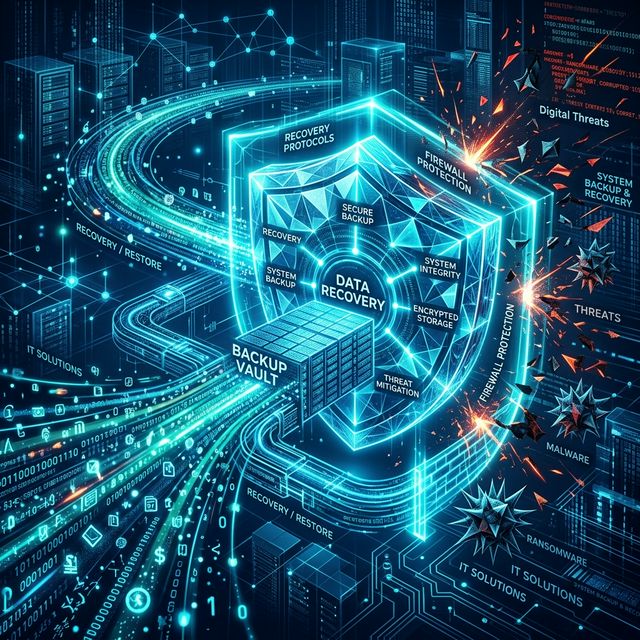
Backup and disaster recovery should be tested, not assumed
Many companies assume that having backups means they are protected. This assumption can lead to significant costs. A backup plan is robust only if data can be restored reliably, quickly, and in a manner that keeps operations running even under pressure.
Enterprise IT solutions treat backup and disaster recovery as ongoing operational processes. Data is copied regularly, securely stored, and its restoration is tested on a set schedule. Recovery objectives are defined with the business’s needs in mind, helping leaders know what to restore first, how long recovery might take, and which systems have necessary redundancy.
This planning is helpful not only for major disasters, but also for everyday challenges like accidentally deleted files, corrupted servers, ransomware incidents, or unexpected synchronization errors in cloud applications. A prepared environment, supported by an effective IT strategy and automation tools, reacts calmly and quickly, reducing downtime and limiting the impact on business operations.
Scalability without constant disruption
Growth can strain an inadequate infrastructure. As a business grows, more users, devices, applications, data, and locations demand increased system capacity. Enterprise IT solutions prevent constant disruption by establishing clear standards. With centralized management, new employees can be onboarded quickly, access controls are implemented uniformly, and devices are configured consistently across different offices or regions. This includes efficient customer relationship management and supply chain management systems that scale with business expansion.
Cloud and virtual infrastructure can expand without the need to rebuild the environment from scratch. This approach means that every company does not need an overly complex technology setup, only a design that can scale smoothly. A practical strategy involves documented systems, lifecycle planning, and flexible infrastructure choices that move in line with demand while leveraging digital transformation initiatives.
What business leaders gain beyond technical stability
Enterprise IT solutions not only reduce downtime but also enable better decision-making. When leaders trust their technology, planning becomes more confident and strategic.
Reliable systems boost overall productivity. Sales teams access customer data seamlessly, finance teams trust their reporting mechanisms, operations teams coordinate smoothly across locations, and client-facing teams provide uninterrupted service. In turn, many companies experience more predictable spending, minimized productivity losses, and lower emergency costs thanks to a well-managed IT environment that integrates ERP, automation, and business intelligence.
A robust IT framework offers a competitive edge by delivering cost efficiency, better resource management, and fewer disruptions, all of which contribute significantly to a company’s sustained growth and smooth adoption of digital transformation.
Build-versus-buy is not the only question
Many assume the choice is between building a large internal IT team and handling everything themselves. In reality, there is a flexible middle ground. Managed IT services offer enterprise-level oversight, continuous monitoring, skilled administration, and strong cybersecurity support without necessitating a large in-house department.
This model suits companies that need comprehensive technical management while maintaining predictable costs and accessing specialized expertise. It is especially beneficial for organizations with internal staff that require additional support in areas like infrastructure design, security hardening, backup strategies, or server management across diverse platforms. Integrating systems such as ERP, automation, and customer relationship management can further streamline operations and enhance supply chain management.
Working with a provider that uses a preventive operating model helps standardize systems, reduce repeated issues, and support long-term planning without slowing business momentum.
How to assess whether your business is ready
The signals are clear once leaders understand what to look for. Frequent system delays, inconsistent security tasks, or untested backups may indicate that a business has outgrown its current setup. Similarly, rapid growth added through new offices, remote teams, cloud tool adoption, or handling more sensitive data increases the stakes and calls for a stronger IT structure.
Key questions to consider include:
- Reliability: Do critical systems have continuous monitoring, routine maintenance, and documented recovery plans?
- Security: Are access controls, patch management, and endpoint protections enforced consistently?
- Scalability: Can the infrastructure support additional users, locations, and workloads without strain, while integrating digital transformation, ERP, and business intelligence effectively?
- Visibility: Can leaders easily access clear reports on system health, risks, and recurring issues?
- Support model: Does the business still respond to failures instead of preventing them?
These considerations encourage discussions that move from isolated tools to a fully prepared operational framework that includes advanced technologies like automation and customer relationship management.
Choosing a partner that fits the business
Effective technology support reflects business priorities rather than a set list of generic tasks. A logistics company may require uninterrupted connectivity across numerous sites, a healthcare practice might need secure patient data access, and an e-commerce business requires high availability and swift recovery for customer platforms. Integrating ERP, automation, and business intelligence in these environments can significantly enhance customer relationship management and supply chain management.
The best IT approach is tailored to meet these requirements through practical systems, clear accountability, and a consistent service model. This may involve proactive monitoring, remote administration, regular backup management, enforced security controls, infrastructure tuning, and ongoing support that grows alongside the business. With a solid IT strategy, organizations can harness digital transformation to streamline processes and ensure every component, from ERP to cybersecurity, is working harmoniously.
For companies seeking reliable systems without expanding a large in-house IT function, managed providers offer a strong foundation. With the appropriate structure established, technology transforms from a recurring source of disruption into a dependable engine for business growth, enhanced by automation and integrated customer relationship management solutions.
Originally published on CyberNet