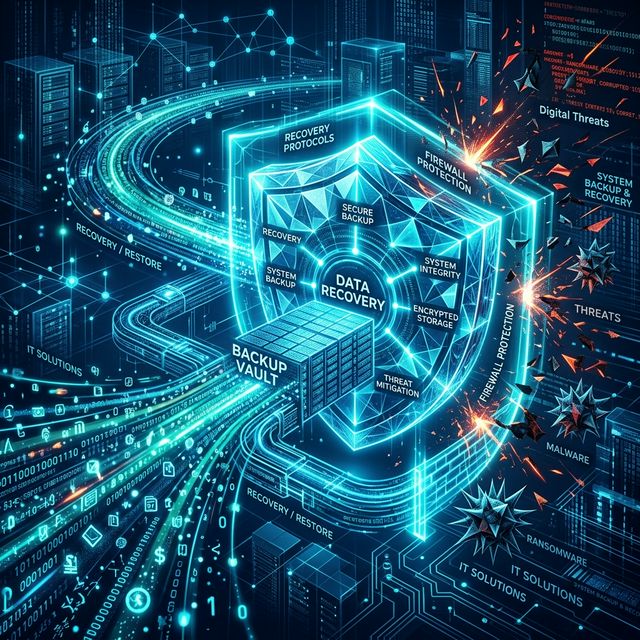
Enterprise IT Solutions: Building Technology That Scales With Your Business

Why Enterprise IT Solutions Are the Backbone of Modern Business
In an era where digital transformation defines competitive advantage, enterprise IT solutions have become the strategic foundation upon which successful businesses are built. These are not simple technology purchases — they are comprehensive, integrated systems designed to support complex operations, enable growth, and drive innovation at scale.
Whether you are a mid-market company preparing for rapid expansion or a large organization optimizing existing operations, the right enterprise IT solutions determine how effectively you can respond to market demands, serve customers, and outpace competitors.
What Defines Enterprise IT Solutions?
Enterprise IT solutions differ from standard business technology in several fundamental ways:
Scale and Complexity
Enterprise solutions are designed to handle thousands of users, massive data volumes, and mission-critical workloads. They incorporate redundancy, load balancing, and high availability by design — not as afterthoughts.
Integration and Interoperability
Modern enterprises run dozens or hundreds of applications. Enterprise IT solutions are built to integrate seamlessly through APIs, middleware, and standardized protocols, creating a unified technology ecosystem rather than isolated silos.
Security and Compliance
Enterprise environments face heightened regulatory requirements and sophisticated threat actors. Enterprise IT solutions include robust security architectures, compliance frameworks, and audit capabilities that meet standards like ISO 27001, GDPR, SOC 2, and industry-specific regulations.
Governance and Management
Enterprise solutions include centralized management tools, role-based access controls, change management processes, and comprehensive logging and reporting capabilities.
The Core Pillars of Enterprise IT Solutions
Building an effective enterprise IT environment requires excellence across several interconnected technology domains:
1. Enterprise Infrastructure Architecture
The physical and virtual infrastructure that powers your applications and data is the foundation of everything else. Modern enterprise infrastructure includes:
Data Center and Colocation
- Purpose-built or leased data center facilities with redundant power and cooling
- Physical security controls including biometrics, surveillance, and access logging
- High-density compute environments optimized for performance and energy efficiency
Server and Compute Platform
- Enterprise-grade server hardware from Dell, HPE, or Lenovo with redundant components
- Virtualization platforms (VMware vSphere, Microsoft Hyper-V) for workload consolidation
- Container orchestration (Kubernetes, Docker Swarm) for cloud-native applications
Storage Architecture
- SAN and NAS solutions for centralized, high-performance storage
- Software-defined storage for flexibility and scalability
- Tiered storage strategies that balance performance, capacity, and cost
Network Infrastructure
- Campus and WAN networking with redundant paths and automatic failover
- Software-defined networking (SDN) for programmable network management
- Network segmentation and micro-segmentation for security
2. Cloud and Hybrid Infrastructure
The modern enterprise rarely operates entirely on-premises or entirely in the cloud. The most effective strategy is typically a hybrid approach:
Public Cloud Services
- Infrastructure as a Service (IaaS) for scalable compute and storage
- Platform as a Service (PaaS) for application development and deployment
- Software as a Service (SaaS) for productivity, CRM, ERP, and collaboration
Private Cloud
- Dedicated cloud infrastructure for sensitive workloads and regulated data
- Greater control over data residency, security configurations, and performance
- Compliance advantages for industries with strict data sovereignty requirements
Hybrid Cloud Orchestration
- Unified management of on-premises and cloud resources through a single pane of glass
- Workload placement optimization based on cost, performance, and compliance requirements
- Seamless data synchronization between environments
- Disaster recovery and business continuity across multiple locations
3. Enterprise Security Architecture
Security at the enterprise level requires a comprehensive, defense-in-depth approach:
Security Operations Center (SOC) A centralized facility — either internal or managed — that monitors, detects, analyzes, and responds to security incidents 24/7/365. The SOC correlates data from across your entire infrastructure to identify sophisticated threats that individual tools might miss.
Zero Trust Architecture The zero trust model operates on the principle of "never trust, always verify." Every user, device, and application must be authenticated and authorized before accessing resources, regardless of network location. Key components include:
- Identity-centric security with strong authentication
- Micro-segmentation to limit lateral movement
- Continuous monitoring and adaptive access policies
- Encrypted communications everywhere
Threat Intelligence and Hunting Proactive security goes beyond waiting for alerts. Enterprise security includes threat intelligence feeds, behavioral analytics, and dedicated threat hunting teams that actively search for indicators of compromise within your environment.
4. Business Continuity and Disaster Recovery
Enterprise-grade business continuity planning ensures your operations can withstand any disruption:
Recovery Architecture
- Active-active or active-passive configurations for critical systems
- Geographic redundancy across multiple data centers or cloud regions
- Automated failover with minimal Recovery Time Objectives (RTO)
- Near-zero Recovery Point Objectives (RPO) for mission-critical data
Testing and Validation
- Regular disaster recovery exercises including full-scale failover tests
- Tabletop exercises for incident response teams
- Documented runbooks for every recovery scenario
- Post-exercise improvement reviews
5. IT Service Management (ITSM)
Enterprise operations require structured processes for managing IT services:
- Incident Management: Rapid detection, classification, and resolution of service disruptions
- Change Management: Controlled processes for implementing infrastructure changes
- Problem Management: Root cause analysis to prevent recurring incidents
- Configuration Management: Accurate tracking of all IT assets and their relationships
- Service Level Management: Defining, monitoring, and reporting on service performance
The Strategic Impact of Enterprise IT Solutions
Organizations that invest in comprehensive enterprise IT solutions gain measurable advantages:
Operational Efficiency
Integrated systems eliminate manual processes, reduce errors, and accelerate workflows. According to McKinsey, organizations with mature digital infrastructure achieve 20-30% higher operational efficiency than their peers.
Revenue Growth Enablement
Scalable infrastructure allows businesses to launch new products, enter new markets, and serve new customers without technology constraints limiting growth velocity.
Risk Reduction
Comprehensive security, backup, and disaster recovery reduce the financial and reputational risk of cyber incidents and operational disruptions.
Competitive Differentiation
Organizations with superior technology infrastructure can deliver better customer experiences, faster innovation cycles, and more responsive service — creating sustainable competitive advantages.
How CyberNet Delivers Enterprise IT Solutions
CyberNet helps organizations design, implement, and manage enterprise IT solutions that drive business results. Our enterprise capabilities include:
- Infrastructure architecture design — from data center to cloud, we design scalable, resilient environments
- Hybrid cloud implementation — seamless integration of on-premises and cloud resources
- Enterprise security — multi-layered protection with 24/7 monitoring and incident response
- Disaster recovery and business continuity — tested, documented, and proven recovery capabilities
- IT service management — ITIL-aligned processes for service delivery excellence
- Strategic consulting — technology roadmapping aligned with your business objectives
With over a decade of experience and 500+ enterprise clients, we understand the unique challenges of building and maintaining technology at scale.
Ready to build enterprise IT solutions that grow with your business? Contact CyberNet today for a free infrastructure assessment and strategic consultation.
Originally published on CyberNet